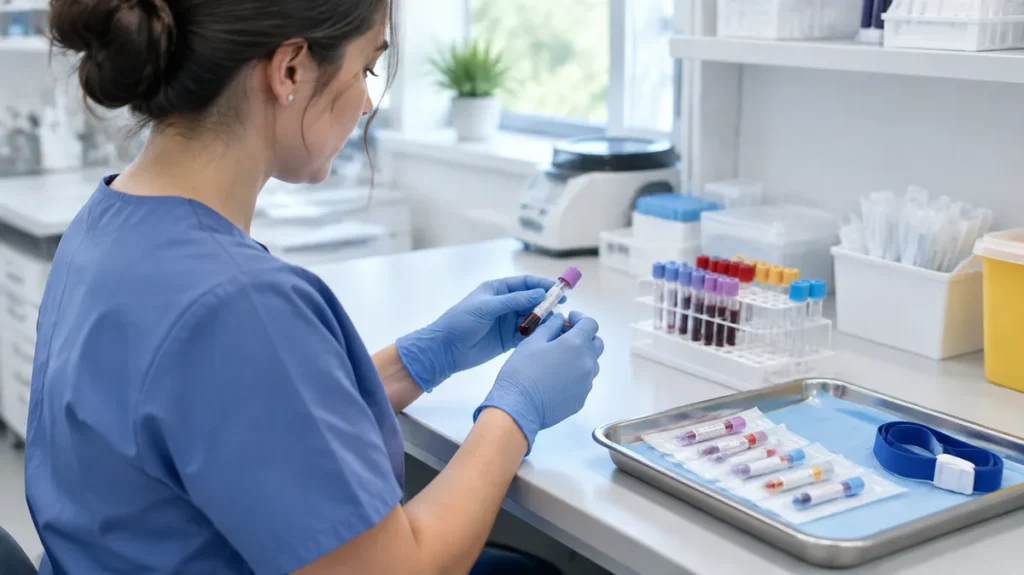
Becoming a medical laboratory assistant in Canada is one of the shorter routes into clinical healthcare. There is no degree requirement and no multi-year apprenticeship. You complete a medical laboratory assistant training program that includes a supervised practicum, and in British Columbia you then apply for certification with the BC Society of Laboratory Science. For most people the training takes under a year.
This guide sets out the steps in order, how long each one takes, and what the role pays once you are in it.
How to Become a Medical Laboratory Assistant: The Steps
Step 1: Check the work actually suits you
This is the step most people skip, and it is the cheapest one to get right. Medical laboratory assistants draw blood from patients several times an hour, handle biological specimens, follow fixed procedures with no room for improvisation, and work to someone else’s priorities when urgent samples arrive. If that sounds like a good day, the rest of the pathway is straightforward. Read what a medical laboratory assistant does day to day before you commit money to training.
Step 2: Confirm you meet the entry requirements
Entry requirements are set by each institution and can change between intakes, so check them against the program itself rather than against a general article. The current requirements for the Medical Laboratory Assistant Certificate are listed on the program page, and admissions can confirm anything that is unclear about your particular situation.

Step 3: Complete the classroom and laboratory training
This is the bulk of the pathway. Training covers the theory you need to work safely and the technical procedures you will use daily. At Edison College that is 30 weeks, 750 hours, covering medical terminology, laboratory safety and asepsis, phlebotomy, hematology, clinical microbiology, clinical chemistry, urinalysis and bodily fluids, the cardiovascular system and ECGs, and laboratory mathematics and measurements.
Phlebotomy is the part worth preparing for mentally. Drawing blood competently and calmly is a practised physical skill, and it is learned under supervision rather than from a textbook.
Step 4: Complete the practicum
The practicum is where training becomes employable experience. At Edison College it is 6 weeks, 120 hours, completed in person at a partner laboratory. You work real specimens, real patients and real turnaround pressure, with supervision. It is also, in practice, where many people make the professional contacts that lead to a first job.
Step 5: Apply for certification, then for jobs
In British Columbia, graduates of a BCSLS-approved program can apply for certification with the BC Society of Laboratory Science after graduation. Edison College’s Medical Laboratory Assistant program is on that approved list. Certification is applied for as a separate step — completing the program does not confer it automatically, so budget time for the application rather than assuming it arrives with your certificate.
From there you apply to the settings that employ this occupation: hospital laboratories, private and community laboratories, specimen collection centres, community clinics, and public health or research laboratories.
How Long Does It Take to Become a Medical Lab Assistant?
The Edison College program runs 36 weeks and 870 hours in total:
| Stage | Duration |
|---|---|
| Theory | 30 weeks / 750 hours |
| Practicum | 6 weeks / 120 hours |
| Total | 36 weeks / 870 hours |
Add time either side for the application and intake date at the start, and the certification application at the end.
What Medical Laboratory Assistants Earn
The Government of Canada Job Bank puts the median wage for NOC 33101 at $27.00 an hour nationally, with a range from $19.18 to $36.11. In British Columbia the median is $28.00, with a range from $20.50 to $31.00. Wages were updated 19 November 2025 for the 2023 to 2024 reference period, sourced from the Statistics Canada Labour Force Survey (retrieved 13 November 2026).
These are figures for everyone working in the occupation at every level of experience, not a starting wage and not a graduate outcome. For the provincial breakdown, see how much medical laboratory assistants earn in Canada.

Job Outlook
Job Bank publishes a three-year employment outlook for this occupation province by province, rated on a scale from Very limited to Very good. For the 2025 to 2027 period the outlook is rated Moderate in British Columbia, Alberta, Ontario and Manitoba (outlooks updated 10 December 2025, retrieved 13 November 2026). Ratings vary by economic region within each province, and some regions sit higher than their provincial rating.
Separately, WorkBC designates medical laboratory assistants and related technical occupations a High opportunity occupation in British Columbia. Because these ratings are revised on the publishers’ own schedule, check the current figure at the source before relying on it.

Where the Pathway Can Lead
Within the role, experience brings more complex specimen handling, busier settings and senior or lead assistant responsibilities. Beyond it, the most common next step is training as a medical laboratory technologist, who performs and interprets more complex testing. That is a separate and longer credential, not a promotion that arrives with time served — but the assistant certificate is a legitimate way to test the field before committing to it.
Start the Pathway at Edison College
The Medical Laboratory Assistant Certificate at Edison College is a 36-week, 870-hour program ending in a 6-week practicum at a partner laboratory, and it is on the BCSLS approved list.
The program is delivered in Victoria, British Columbia: theory is studied online, and the hands-on laboratory training and practicum are completed in person. If you are weighing up relocating or commuting for the in-person components, contact us and we will talk you through the schedule before you apply. Edison also offers career services for the job-search stage.
Frequently Asked Questions
How do I become a medical lab assistant in Canada?
Complete a medical laboratory assistant training program that includes a supervised practicum, then, in British Columbia, apply for certification with the BC Society of Laboratory Science. Entry requirements are set by the institution, and no degree is required.
How long does it take to become a medical laboratory assistant?
Edison College’s Medical Laboratory Assistant Certificate is 36 weeks, or 870 hours: 30 weeks of theory and a 6-week, 120-hour practicum. Allow extra time for the intake date and the certification application.
Do I need to be certified to work as a medical laboratory assistant?
In British Columbia, graduates of a BCSLS-approved program can apply for BCSLS certification after graduation. Certification is a separate application and is not automatic on completing a program. Requirements differ by province, so check the body in the province where you intend to work.
Is a medical laboratory assistant the same as a technologist?
No. Assistants collect and process specimens and perform defined routine tests. Technologists carry out and interpret more complex testing and hold a separate, longer credential.
What does a medical laboratory assistant earn in Canada?
Job Bank reports a median of $27.00 an hour nationally for NOC 33101 and $28.00 in British Columbia, based on wages updated 19 November 2025 for the 2023 to 2024 reference period. These are occupation-wide figures, not starting wages.
Pictures by Freepik