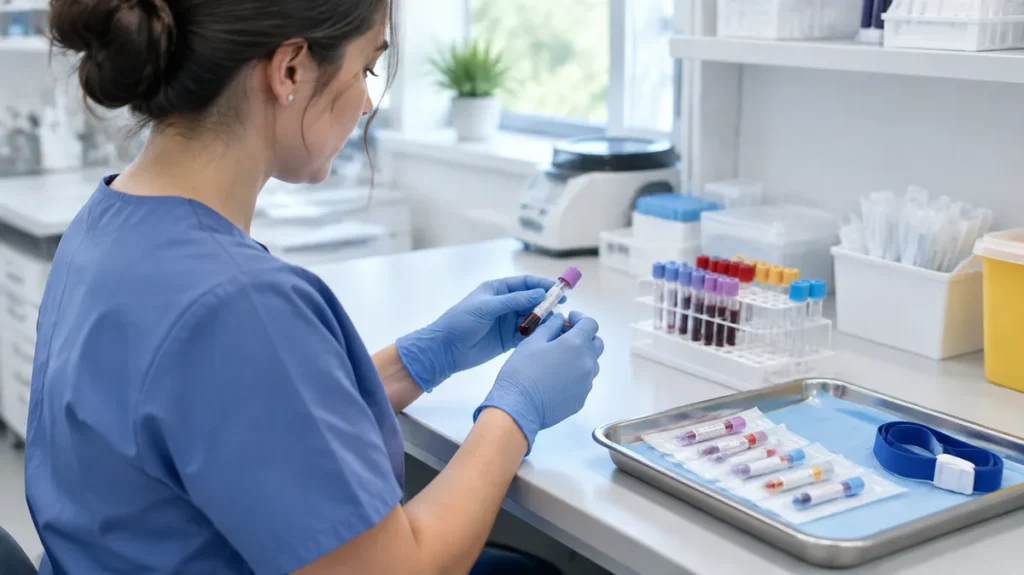

A medical laboratory assistant (MLA) collects and prepares patient samples, performs routine laboratory tests, runs ECGs and keeps the records that every laboratory result depends on. MLAs work under the direction of medical laboratory technologists in hospital and private laboratories, specimen collection centres, community clinics and public health laboratories.
This guide covers what the job involves day to day, where medical laboratory assistants work, the five qualities that separate a strong MLA from an adequate one, and how training builds them.
What Does a Medical Laboratory Assistant Do?
Medical laboratory assistants support medical laboratory technologists and other laboratory professionals. Typical duties include:
- collecting blood samples (phlebotomy);
- receiving, labelling, processing and accessioning specimens;
- performing electrocardiograms (ECGs);
- carrying out basic tests in areas such as urinalysis, hematology and clinical chemistry;
- following quality control, safety and infection control procedures;
- recording patient and specimen information accurately;
- preparing reagents, maintaining equipment and disposing of biohazardous waste safely.
One boundary matters. An MLA collects, processes and runs defined tests. Interpreting results and reporting diagnostic findings belongs to technologists and pathologists. Knowing where your scope ends, and escalating promptly when something falls outside it, is part of doing the job properly.

Where Medical Laboratory Assistants Work
- Hospital laboratories — the widest range of testing, often with the busiest urgent workload.
- Private and community laboratories — high throughput of routine testing.
- Specimen collection centres — patient-facing, with a high volume of blood draws.
- Community clinics — collection and basic testing alongside other clinical staff.
- Public health and research laboratories — specimen handling for surveillance and study work.
On hours, WorkBC reports that most people in this occupation work 35 to 40 hours a week, and that hospital settings can involve rotating shifts, weekends and on-call work (retrieved 13 November 2026).
A Typical Day in the Laboratory
Most shifts follow the specimen rather than the clock. You confirm patient identification before a collection, draw and label the sample at the bedside or in the collection room, then accession it so the laboratory information system knows exactly what arrived and when. Samples are centrifuged, aliquoted or sent to the right bench. Between that, you run quality control checks, restock, watch for equipment errors and dispose of biohazardous waste to protocol.
Volume is uneven. A clinic outbreak or a busy morning in a hospital can double the number of patients waiting, and urgent (STAT) samples have to move ahead of the queue without the routine work slipping.
Five Qualities of a Successful Medical Laboratory Assistant
1. Attention to Detail
Every sample has to be matched to the right patient, labelled correctly and handled according to procedure. A mislabelled tube or a missed step can produce a delayed or incorrect result for a real person. Strong MLAs:
- double-check patient identification before every collection;
- follow procedures exactly, especially on routine tasks;
- notice when something looks wrong, such as a hemolysed or insufficient sample, and report it rather than passing it on.
2. Accurate Record-keeping
Laboratories depend on records to track a specimen from collection to result. MLAs enter patient information, specimen details and test data, usually in a laboratory information system. Good record-keeping means:
- entering data accurately and completely, the first time;
- documenting each step in the specimen chain of custody;
- keeping patient information confidential.
3. Composure Under Pressure
Labs get busy, and the people in front of you are often anxious about a needle or a result. Composure here is practical, not a personality trait:
- prioritising urgent (STAT) samples without dropping routine work;
- staying patient and reassuring with nervous patients during a blood collection;
- keeping the same quality standard when the workload climbs.

4. Practical Problem-solving
Not every collection or test goes smoothly. A vein can be difficult, a sample can be unsuitable, an analyser can throw an error. The useful version of problem-solving in a regulated laboratory is knowing the limits of your own troubleshooting:
- knowing when to try again and when to ask for help;
- understanding why a procedure exists, so a deviation is obvious;
- escalating to a supervisor or technologist promptly instead of improvising.
5. Care With Specimens and Equipment
MLAs handle biological specimens, chemicals and precise instruments every day. Careful handling protects patients, co-workers and the accuracy of the result:
- following biosafety and infection control procedures;
- using personal protective equipment correctly;
- disposing of hazardous waste safely;
- running quality control checks and reporting equipment problems early.

How MLA Training Builds These Qualities
Formal training gives you supervised practice with these procedures before you work with patients independently. Edison College’s Medical Laboratory Assistant Certificate is a 36-week, 870-hour program:
| Component | Duration |
|---|---|
| Theory | 30 weeks / 750 hours |
| Practicum | 6 weeks / 120 hours |
Courses include Laboratory Safety and Asepsis, Phlebotomy in the Medical Laboratory, Hematology Basics, Clinical Microbiology Basics, Clinical Chemistry Basics, Urinalysis and Bodily Fluids, The Cardiovascular System and ECGs, and Laboratory Mathematics and Measurements. The practicum is completed in person at a partner laboratory, which is where the five qualities above stop being a reading exercise.
BCSLS Certification
The BC Society of Laboratory Science (BCSLS) lists Edison College’s Medical Laboratory Assistant program as an approved program. Graduates of BCSLS-approved programs can apply for BCSLS certification after graduation. Certification is not automatic, and it is a separate step from completing the program.
What Medical Laboratory Assistants Earn
Pay varies by employer and shift. We keep the current WorkBC figures for BC in one place rather than repeating them across articles: see how much medical laboratory assistants earn in BC.
Start Your Medical Laboratory Assistant Training
If the work described above sounds like a fit, the Medical Laboratory Assistant Certificate at Edison College covers the theory and the hands-on practice, and finishes with a practicum in a working laboratory. Edison also offers career services, and you can contact us with questions about admission or the practicum.
Frequently Asked Questions
What skills does a medical laboratory assistant need?
Key skills include attention to detail, accurate record-keeping, the ability to work under pressure, problem-solving, and careful handling of specimens and equipment. Technical skills such as phlebotomy, specimen processing and ECGs are learned through training.
Who supervises medical laboratory assistants?
Medical laboratory assistants typically work with and under the direction of medical laboratory technologists and other laboratory professionals.
How long is Edison’s Medical Laboratory Assistant program?
Edison College’s Medical Laboratory Assistant Certificate is 36 weeks, or 870 hours, including a 6-week, 120-hour practicum.
Is Edison’s MLA program approved by BCSLS?
Yes. The BC Society of Laboratory Science lists Edison College’s Medical Laboratory Assistant program as approved. Graduates can apply for BCSLS certification after graduation; certification is not automatic.
Is a medical laboratory assistant the same as a medical laboratory technologist?
No. Assistants collect and process specimens and perform defined routine tests. Technologists carry out and interpret more complex testing and hold a different credential.
Pictures by Freepik