

The most reliable way to learn machine learning is in order: programming and data foundations first, then core models and evaluation, then deep learning, and finally a complete project you can explain from start to finish. Skipping steps is the most common reason learners stall.
Edison College Canada’s Artificial Intelligence Diploma is built around that sequence. Over 56 weeks, in-class in Victoria, BC or online, students move from Python and mathematics through machine learning, deep learning, natural language processing and computer vision to an end-to-end capstone project. This guide walks through each stage and shows how to learn machine learning & AI with a Diploma
How do you get started with machine learning?
Start with Python, basic data handling and the mathematics needed to understand how models are trained. Then learn regression, classification and evaluation before moving into neural networks.
Set your first goal around a task rather than a job title. “Predict a numerical outcome from a table” gives you something concrete to work on. “Become an AI expert” does not tell you what to practice next.
Your starting point depends on your background:
- New to programming: you need functions, lists, files and debugging before model building. Edison’s diploma begins with Programming Fundamentals and Mathematics for AI for exactly this reason.
- Comfortable with spreadsheets or SQL: your next step is loading, exploring and transforming data in Python, then tackling a prediction problem.
- Experienced developer: focus on experimental design, model evaluation and data quality rather than repeating programming basics.
- Returning learner: rebuild a familiar project and identify which concepts you cannot yet explain on your own.
Why a structured AI diploma makes machine learning easier to learn
Machine learning draws on programming, statistics, data engineering and domain judgement at the same time. Learning it from scattered tutorials often means repeating the basics, missing the parts nobody demonstrates (data cleaning, evaluation, documentation) and never finishing a full project.
A structured diploma solves those problems in practical ways:
- Sequence: each course builds on the previous one, so you are not guessing what to learn next.
- Instructor feedback: someone reviews your work and helps when you are stuck, rather than leaving you to debug alone.
- Breadth and depth: you cover data, models, deep learning, ethics and deployment-related tools in one connected program.
- A finished project: the program ends with a capstone you can document and discuss.
Edison’s Artificial Intelligence Diploma at a glance
| Detail | Edison AI Diploma |
| Credential | Diploma |
| Length | 56 weeks / 1,120 hours |
| Delivery | In-class at the Victoria, BC campus or online |
| Courses | 16, from Programming Fundamentals to a Capstone Project |
| Key tools | Python, Java, SQL, Pandas, NumPy, Matplotlib, TensorFlow, PyTorch, OpenCV, Hadoop, Spark, Power BI, Tableau |
| Practicum | Not included |
| Prior programming experience | Not listed in the admission requirements |
The machine learning workflow, step by step
Almost every machine learning project follows the same cycle: prepare the data, explore it, train a model, evaluate it honestly, then deploy and improve it. Keeping this cycle in view helps you see why each skill matters.
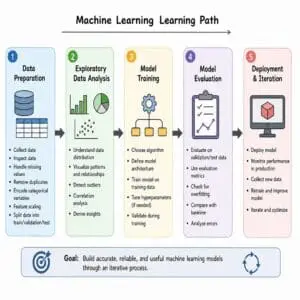
| Workflow stage | Where it is taught in the Edison AI Diploma |
| 1. Data preparation | Programming Fundamentals; Data Science Basics; Database Management |
| 2. Exploratory data analysis | Data Science Basics; Data Visualization Techniques; Mathematics for AI |
| 3. Model training | Introduction to Artificial Intelligence; Machine Learning Fundamentals; Deep Learning Essentials |
| 4. Model evaluation | Machine Learning Fundamentals; Deep Learning Essentials; AI Ethics and Data Governance |
| 5. Deployment and iteration | Software Tools and Emerging Technologies for AI; Web Technologies; Big Data Analytics; Capstone Project |
Stage 1: Build programming, maths and data foundations
Before you train a model, you need to load a dataset, find missing values, summarize a column and chart the result and explain each step. That is the work of the first part of the diploma:
- Programming Fundamentals: core programming principles in Python and Java, including object-oriented basics.
- Mathematics for AI: the linear algebra, calculus, probability and statistics that sit underneath model training. The focus is on what the maths means, not memorizing formulas.
- Data Science Basics: data cleaning and exploratory analysis with Pandas, NumPy and Matplotlib.
- Database Management: relational design and SQL, so you can retrieve and structure the data your models depend on.
One habit worth building early: separate your training and test data before you transform anything. Fitting preprocessing steps on all your data can leak information into the evaluation and make a model look better than it is. Write down your prediction target, what information would really be available at prediction time, and what a useful result looks like.
Stage 2: Learn core machine learning models
With foundations in place, the program moves into the models most real projects start with. Introduction to Artificial Intelligence covers AI concepts, search and early machine learning methods such as decision trees and random forests. Machine Learning Fundamentals covers supervised and unsupervised learning, regression, clustering and the problem of overfitting.
The skill that matters most here is evaluation. A useful model is one you can compare against a simple baseline, whose mistakes you have examined, and whose limits you can explain not simply the one with the highest score.
Stage 3: Move into deep learning through experiments
Deep Learning Essentials introduces neural networks, convolutional neural networks (CNNs), recurrent neural networks (RNNs) and autoencoders using TensorFlow and PyTorch, the two most widely used deep learning frameworks. Treat every deep learning exercise as an experiment rather than a recipe.
Begin with a reproducible baseline
Run a working example without changing it, then record the dataset, model, training settings and result. Save that version before experimenting. Try explaining the code aloud: where data enters, where predictions are made and where parameters are updated. Any step you cannot explain becomes a focused question for your instructor.
Change one decision at a time
Once the baseline works, pick one question a different learning rate, a smaller network, a longer training run and keep everything else the same. Write your expectation down first, then record what happened in a simple experiment log:
- Question: what are you investigating?
- Change: which setting or component did you alter?
- Observation: what happened during training and evaluation?
- Interpretation: what might explain the result, and what is still uncertain?
Rebuild it without copying
Reconstruct a smaller version on your own, then adapt it to a different dataset. Finish by saving the model and loading it again for prediction, with the preprocessing steps alongside it. If you can do that, you understand the workflow rather than just recognizing familiar code.
Stage 4: Apply AI to language, images and large datasets
Machine learning becomes more concrete when you apply it to specific kinds of data. The diploma includes dedicated courses for each:
| Course | What you work with |
| Natural Language Processing | Text: tokenization, embeddings, named-entity recognition, sentiment analysis and chatbots |
| Computer Vision Basics | Images: image processing, object recognition and facial recognition with OpenCV |
| Big Data Analytics | Large datasets: Hadoop, Spark, HDFS, NoSQL and PySpark |
| Data Visualization Techniques | Communicating results: dashboards in Power BI and Tableau |
| Web Technologies | Interfaces: HTML, CSS, JavaScript and PHP for AI-enabled web applications |
If your interest leans more toward analysis and reporting than building models, compare Edison’s Data Analyst Diploma as well.
Stage 5: Build AI responsibly
Knowing how to build a model is only half the job; knowing when it should not be trusted is the other half. AI Ethics and Data Governance covers bias, transparency, privacy, data quality and security the questions every AI project should answer before anyone relies on it.
The same discipline applies to generative AI. Define the expected behaviour before experimenting with prompts or settings, create representative test inputs, include cases where the system should decline or ask for clarification, and keep a record of failures instead of showcasing only the best outputs.
Stage 6: Turn your learning into a capstone project
The diploma closes with a Capstone Project: an end-to-end AI project that runs from problem definition through to documentation and presentation, with an emphasis on practical problem-solving and teamwork. It is where the separate skills from every earlier course come together.
A strong capstone is built around a real decision. For example, a support-request classifier should show whether its predictions would help someone route requests, which mistakes matter most, and how it compares with a simple baseline. Package the work so someone else can follow it:
- Problem statement: the intended user, prediction task and boundaries.
- Data notes: where the data came from, permitted use, exclusions and known gaps.
- Reproduction steps: the environment and how to run the experiment.
- Results: the baseline, model evaluation and selected error examples.
- Limitations: what has not been tested and what would need review before real use.
Alongside the capstone, the Career Prep course covers resumes, cover letters, LinkedIn profiles and mock interviews, so you can present your project work clearly to employers.
What to look for in an AI program and how Edison compares
Whichever program you consider, check it against the work you want to be able to do. Here is how Edison’s AI Diploma answers the key questions:
| Question to ask | Edison AI Diploma |
| Does it start where I am? | Yes it opens with Programming Fundamentals and Mathematics for AI, and prior programming experience is not listed as an admission requirement. |
| Is it hands-on? | Courses use working tools Python, SQL, TensorFlow, PyTorch, OpenCV, Spark, Power BI and the program ends with a capstone project. |
| Does it cover the full workflow? | Yes from data preparation and databases through models, deep learning, visualization and deployment-related tools. |
| Does it cover responsible AI? | Yes a dedicated AI Ethics and Data Governance course. |
| Can I fit it around my life? | It is offered in-class in Victoria, BC or online. |
| Will I finish with work I can show? | The Capstone Project produces documented, presentable work. |
Is Edison’s AI Diploma right for you?
The diploma suits learners who want a guided, full-length path into AI and data work rather than a short introduction career changers, people with some technical or analytical background who want to go deeper, and beginners willing to commit to building foundations properly.
Be realistic about the commitment. It is a 56-week program, it does not include a practicum, and like any education program it cannot guarantee employment. If you are still weighing cost, time and format, read Is an Artificial Intelligence Course Worth It?.
Frequently asked questions
Do I need coding experience to join Edison’s AI Diploma?
Edison does not list prior programming experience among the admission requirements for the Artificial Intelligence Diploma. The program begins with Programming Fundamentals, which covers Python and Java. Check the program page for the full admission requirements, including English and math.
How much math’s do I need for machine learning?
You need enough algebra, probability and statistics to understand how models are trained and evaluated. Edison’s Mathematics for AI course covers linear algebra, calculus, probability and statistics as they apply to AI.
Does the program teach TensorFlow and PyTorch?
Yes. Both are covered in Deep Learning Essentials and in Software Tools and Emerging Technologies for AI, alongside Pandas and NumPy.
How long is the AI Diploma, and can I study online?
The program is 56 weeks (1,120 hours). It is offered in-class at Edison’s Victoria, BC campus or online.
How much does the AI Diploma cost?
As published on the program page in November 2026, tuition is $17,109.60 plus $2,132 in course materials, for a total of $19,241.60 (CAD). Edison College Canada is a StudentAid BC designated institution, and eligible students may be able to apply for StudentAid BC funding; eligibility depends on the student and the program.
What careers does the AI Diploma prepare students for?
The program is designed to prepare students for entry-level roles such as junior data analyst, AI model tester/QA analyst, AI support specialist and junior machine learning analyst. Employment depends on the employer, labour market, prior experience and the graduate’s own qualifications.
Start your path into machine learning
If you want a structured route from Python and data foundations through machine learning, deep learning and a capstone project, explore Edison College’s Artificial Intelligence Diploma. Review the full curriculum, admission requirements and upcoming start dates, or request information to speak with an admissions advisor about whether the program fits your goals.
Images from Canva