

A community support worker certificate is a credential built around one core idea: preparing people to help others navigate daily life, access services and build stability — often people facing addiction, mental health challenges or other barriers. If you’re weighing a community support worker certificate or a community mental health worker certificate specifically, this breaks down what the credential actually prepares you to do, where it’s used, and who tends to find the work a good fit.
What a Community Support Worker Certificate Actually Prepares You For
At a practical level, certificate coursework in this field is generally built around:
- Building supportive, trust-based relationships with clients over time
- Helping clients access housing, income supports, healthcare or addiction/mental health services
- Supporting daily living skills — budgeting, scheduling, appointments, self-care routines
- Documenting client progress and communicating with a broader care team
- De-escalating crisis situations and knowing when to refer to other professionals
- Advocating for clients within systems that can be difficult to navigate alone
It’s rarely a desk job. Much of the work happens in the community — client homes, shelters, drop-in centres — rather than in a single fixed location.
Typical Settings Where Certificate Holders Work

People holding this kind of certificate are typically employed across settings such as:
- Community mental health and addictions programs
- Supportive and transitional housing
- Non-profit and social service agencies
- Shelters and outreach programs
- Group homes and residential support settings
- Community health centres
This describes the types of settings the certificate is generally used in — not a claim about where any specific graduate will be employed. Actual placement depends on the employer, the local job market, prior experience and the individual’s own qualifications.
The Community Mental Health and Addictions Focus
A general community support worker certificate can span many populations. A community mental health worker certificate with an addictions and mental health focus narrows toward:
- Understanding substance use and addiction as a health issue, not a moral one
- Recognizing signs of mental health crisis and knowing appropriate response steps
- Trauma-informed approaches to client interaction
- Harm-reduction principles as applied in community settings
- Working alongside , not replacing , clinical mental health and addictions professionals
This specialization is usually the deciding factor between a general support-worker certificate and one focused specifically on mental health and addictions.
Core Skills the Certificate Builds
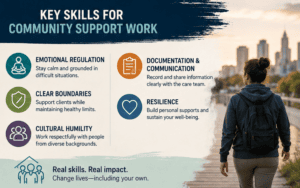
Beyond curriculum content, the certificate is built to develop:
- Emotional regulation — staying calm and grounded in difficult, sometimes crisis-level situations
- Clear boundaries — supporting clients without becoming their sole support system
- Cultural humility — working respectfully with clients from backgrounds different from your own
- Documentation and communication — translating client interactions into clear records for a broader care team
- Resilience — this work involves real emotional weight, and sustainable practice means having your own supports in place
How This Certificate Differs from Related Credentials
Titles and credentials in this field get used loosely, so it’s worth being precise.
|
Credential |
Typical scope |
Regulatory status in BC |
|
Community Support Worker Certificate |
Direct, day-to-day support; navigation, stabilization, harm reduction |
Not a regulated/protected title in BC |
|
Registered Social Worker |
Broader clinical and systems-level practice, case management, some clinical assessment |
Protected title; requires registration with the profession’s regulatory body |
|
Health Care Assistant Certificate |
Personal care and health-support tasks, often in residential or home-care settings |
Distinct scope from CSW; BC Care Aide Registry applies specifically to HCA programs |
A community support worker certificate and a Registered Social Worker designation are not equivalent or interchangeable. If a role you’re considering requires registration as a social worker, confirm the specific education and registration requirements directly with the BC College of Social Workers before assuming a certificate program meets that requirement.
Who This Certificate Tends to Suit -and Who It May Not
This certificate path tends to suit people who:
- Want direct, relationship-based work rather than primarily clinical or administrative work
- Can hold steady boundaries while staying genuinely present with people in crisis
- Are comfortable with unpredictability — no two shifts look the same
- Want to work within community and non-profit settings rather than a single institutional setting
It may be a harder fit for people who:
- Need a highly structured, predictable daily routine
- Find sustained exposure to others’ crises emotionally difficult to manage long-term without support
- Are specifically seeking a clinical or diagnostic scope of practice — that generally requires a different educational and regulatory path
Neither is a value judgment — it’s a genuine fit question worth answering honestly before committing time and tuition.
What the Certificate Involves – Curriculum, Format and Cost
Programs offering this certificate combine coursework covering addictions, mental health and community-support theory with a supervised practicum component that applies those concepts in a real setting. Length, delivery format and curriculum focus vary between institutions, so compare programs directly rather than assuming they’re interchangeable.
Edison College’s Community Support Worker: Addictions & Mental Health Specialization delivers this certificate over 25 weeks / 600 hours, online/distance. The program FAQ publishes a program cost of $12,708 (retrieved from the current program page; confirm the live figure before relying on it, as tuition is subject to change). The program page has current curriculum, admission requirements and cost details.
FAQ
What does a community support worker certificate qualify you to do? It prepares graduates for direct-support roles helping clients navigate daily life, access services and build stability — not for clinical diagnosis or treatment, which falls to a different scope of practice.
Is a community mental health worker certificate the same as a social work degree? No. Community Support Worker is not a regulated title in BC, while Registered Social Worker is a protected title requiring separate registration and typically a different level of education.
How long does it take to complete a community support worker certificate? Program length varies by institution. Edison College’s Community Support Worker: Addictions & Mental Health Specialization runs 25 weeks / 600 hours, delivered online/distance.
Does the certificate include hands-on experience? Yes — programs in this field typically include a supervised practicum component. Confirm current practicum details directly with the institution, since this is a learning requirement, not a job placement guarantee.
CTA: If this matches the certificate you’re looking for, Edison College’s Community Support Worker: Addictions & Mental Health Specialization program has current curriculum, admission and cost details.
Contact us today for more information on this program.
Read more industry-related blogs here.