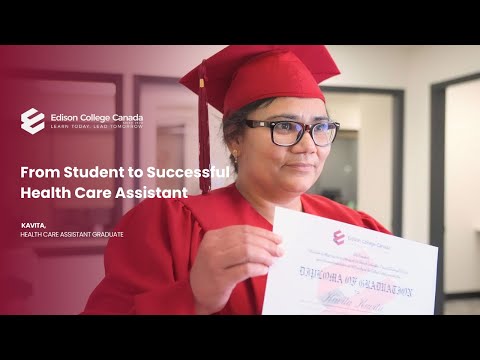

“My experience at Edison College Canada has been very rewarding. The Community Support Worker program, especially the Mental Health and Addiction specialization, has helped me build confidence and real-world skills to support vulnerable individuals in my community. I feel more prepared for my future career.”
Health care assistants are among the most needed front-line workers in British Columbia — and for graduates who want to enter the workforce with not only the credentials but the direct employer relationships and hands-on experience that health care organizations value most, the Co-op version of Edison College’s HCA program offers a meaningful advantage.
The B.C. labour market for HCAs is exceptional by any measure. WorkBC has designated nurse aides, orderlies, and patient service associates — the occupational group that includes health care assistants — as a High Opportunity Occupation. HCAs (NOC 33102) in B.C. can expect approximately 22,990 job openings between 2025 and 2035, with average annual earnings of $49,756 WorkBC — one of the largest projected job opening totals of any health care role in the province, and a direct reflection of B.C.’s ageing population and expanding care infrastructure.
Demand is especially high in long-term care facilities and privately-run institutions, and in rural and remote areas. As the Canadian population aged 85 and older continues to grow rapidly, demand for care aides will continue to increase for years to come. WorkBC
What distinguishes this program is the 24-week paid co-op placement — 495 hours of real, supervised, employer-facing work experience completed after the clinical and theory phases of the program. In a health care labour market where B.C. health authorities and private care operators are actively competing to attract and retain trained staff, the co-op placement gives graduates a critical opportunity to build a professional reputation with a specific employer before they ever submit a formal job application. Almost every region of B.C. has strong demand for HCAs, meaning graduates can live and work almost anywhere in the province once they receive recognized training and register. Vancouver Coastal Health
This program has been reviewed and approved by the PTIRU, delivers the provincial HCA curriculum, and enables graduates to register with the BC Care Aide & Community Health Worker Registry — the registration required to work in any publicly funded health care setting in B.C.
Sources: WorkBC — NOC 33102 | Government of Canada Job Bank — Health Care Aide BC | Choose2Care BC
Graduates of the HCA with Co-op diploma are prepared for the same full spectrum of front-line caregiving roles as the standard HCA program — with one powerful addition: the co-op placement often becomes a student’s first employer, turning supervised work experience directly into a job offer. Career opportunities include:
Residential & Long-Term Care:
- Care Aide — Complex / Long-Term Care
- Care Aide — Dementia / Memory Care Unit
- Care Aide — Multi-Level Care Facility
- Residential Care Worker
Community & Home-Based Settings:
- Home Support Worker
- Community Health Worker
- Assisted Living Worker
- Group Home Worker
- Adult Day Care Worker
Acute & Specialized Care:
- Acute Care Aide (Hospital Setting)
- Palliative / Hospice Care Aide
- Mental Health Support Worker (Care Aide)
- Rehabilitation Care Aide
Additional Settings:
- Patient Service Associate
- Orderly (Hospital)
- Hospice / End-of-Life Care Aide
Care aides work in hospitals and private and public long-term care facilities — including group homes, hospices, and facilities focused on acute care, long-term care, multi-level/complex care, dementia care, assisted living, mental health, and pre- and post-surgery care. WorkBC
The co-op placement — completed in a real B.C. care setting under employer supervision — is where many graduates make the professional connections and demonstrate the practical competence that leads directly to a casual, part-time, or full-time employment offer. In B.C.’s health care labour market, being a known, trusted, trained worker within a specific care organization is a significant hiring advantage.
HCA Co-op graduates work in the same range of B.C. care settings as standard HCA graduates — but with the added depth of having already spent 24 weeks working inside one of those environments before they graduate. Co-op placements introduce students to the real rhythms, teams, and professional expectations of health care work well before their first day of paid employment.
Long-Term Care & Complex Care Facilities: The most common co-op and employment setting for HCA graduates in the Victoria region — residential care homes, complex care facilities, and dementia care units operated by Island Health, private care societies, and independent operators across Greater Victoria and Vancouver Island. Students completing their co-op in these settings gain experience with the full scope of resident care, shift-based work, and multidisciplinary team collaboration.
Home Support & Community Care: Co-op placements in home support agencies give students experience providing personal care to clients in their own homes — an environment that emphasizes client independence, communication skills, and adaptability. Many home support employers actively recruit from their co-op student cohorts.
Acute Care Hospitals: Island Health’s hospital network — including Royal Jubilee Hospital and Victoria General Hospital — employs HCAs and patient service associates in acute care, surgical, palliative, and rehabilitation settings. Hospital-based co-op placements offer exposure to faster-paced clinical environments and broader health care team structures.
Assisted Living & Group Homes: Co-op placements in assisted living communities and group homes develop skills in supporting residents with a range of needs while honouring client choice and autonomy — settings where the person-centred care principles developed throughout the HCA curriculum are most directly applied.
Hospice & Palliative Care: Victoria’s hospice and palliative care network provides co-op placements for students with a calling for end-of-life care — one of the most meaningful and emotionally demanding specializations in the HCA role, covered directly in the program’s Palliative Care course.
Care aides usually work 8- to 12-hour shifts, with full-time employees working 36 to 40 hours per week. Evening, weekend, and holiday shifts are common, and on-call and part-time work is also available. WorkBC The co-op placement gives students direct, first-hand experience with the scheduling realities of health care work — preparing them fully for the workforce before graduation.
The salary profile for HCA Co-op graduates mirrors that of standard HCA graduates, with one important distinction: the 495 hours of co-op work experience count toward the 600-hour threshold that unlocks access to Practical Nursing Access programs — meaningfully shortening the time between graduation and the next stage of career advancement.
In British Columbia, health care aides (NOC 33102) typically earn between $22.37 and $29.83 per hour Job Bank, with wages rising as B.C.’s health authorities continue to invest in workforce retention and capacity.
According to the Health Employers Association of BC, the starting hourly wage for HCAs in publicly funded settings ranges from $27.92 to $29.83 (as of April 2024), depending on the employment sector — with eligible employees accessing a comprehensive benefits package and pension plan through the Municipal Pension Plan. Choose2care
WorkBC reports average annual earnings for HCAs in B.C. of approximately $49,756 WorkBC — a reliable, professionally meaningful income supported by collective agreement wage structures in most publicly funded care settings.
The co-op component of this program provides 495 hours of documented, employer-verified work experience in a B.C. care setting. This is a direct and significant head start on the 600 hours of HCA work experience required to qualify for Practical Nursing Access programs — the established pathway from HCA to Licensed Practical Nurse (LPN) designation and the considerably higher earnings that accompany it. Graduates of the Co-op program who transition directly into employment after graduation may reach the 600-hour LPN eligibility threshold faster than graduates of the standard program.
Most graduates start with casual or part-time employment and work up to full-time status gradually Choose2care — and for Co-op graduates, the relationships built during the placement frequently translate into casual or part-time offers from their co-op employer upon graduation, shortening the typical transition-to-employment timeline.
Sources: WorkBC — NOC 33102 | Government of Canada Job Bank — Health Care Aide BC | Choose2Care BC