

How to Become a Payroll Administrator in Canada: Qualifications, Training and Realistic Expectations
There is no single license you need to work in payroll administration in Canada. What employers hiring for payroll roles look for is a combination of three things: accounting fundamentals, working knowledge of payroll legislation, and hands-on experience with accounting and payroll software. A diploma is one of the more direct ways to build all three at once. It is not the only route, and it does not remove an employer’s own experience requirements.
This guide covers what the job actually involves, what your training options are, how long they take, what they cost, and where automation genuinely fits into the picture.
What does a payroll administrator do?
A payroll administrator makes sure people get paid correctly and on time, and that the employer meets its legal obligations while doing it.
The day-to-day work usually includes:
- collecting and verifying timesheets, hours and pay changes
- calculating gross-to-net pay, including overtime, benefits and deductions
- processing statutory deductions and remittances
- maintaining employee payroll records
- preparing records of employment and year-end tax slips
- answering employee questions about pay, deductions and vacation entitlements
- reconciling payroll accounts against the general ledger
In smaller organizations, one person often handles payroll alongside accounts payable, accounts receivable and general bookkeeping. In larger organizations, payroll is a specialized function inside a finance or HR team.
The work rewards accuracy and consistency more than speed. Payroll errors are visible immediately, they affect people’s income directly, and they can carry regulatory consequences for the employer. If you find detailed, rules-based work satisfying rather than tedious, that is a good signal.
What qualifications do you need to work in payroll?
There is no mandatory license to hold a payroll administration job in Canada. What employers typically ask for falls into four categories.
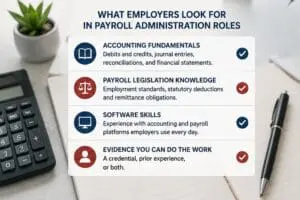
Accounting fundamentals. Debits and credits, journal entries, reconciliations, basic financial statements. You cannot reconcile a payroll account without understanding what sits on the other side of it.
Payroll legislation knowledge. Employment standards, statutory deductions and remittance obligations. These are jurisdiction-specific — British Columbia rules are not Ontario rules, and an employer with staff in several provinces expects you to know the difference.
Software. Accounting and payroll platforms are the daily tool of the job. In job postings, employers name specific software far more often than they name specific credentials.
Evidence you can do the work. A credential, prior experience, or both. This is the barrier most career changers run into: employers want proof, and unstructured self-study rarely produces it in a form a hiring manager recognizes.
Separately from any college program, Canada also has professional payroll designations administered by an independent professional body. Those have their own coursework, examinations and membership requirements, and you apply for them directly. No college diploma grants one automatically. If a designation matters to your plan, check the current requirements with the professional body before you enroll anywhere.
What are your training options?
|
Route |
Typical length |
What it gives you |
What it does not give you |
|---|---|---|---|
|
Self-study and short online courses |
Weeks |
Low cost, complete flexibility |
Little recognized evidence for employers; no structured software practice |
|
Single-subject certificates |
Weeks to a few months |
Focused knowledge in one area |
Narrow scope; usually assumes you already have accounting basics |
|
Diploma programs |
About one year full-time |
Accounting fundamentals, payroll knowledge and software practice in one structured sequence |
Employer experience requirements; any professional designation |
|
Degree programs |
Three to four years |
Broad academic base and a pathway into professional accounting streams |
Speed and cost efficiency if you are targeting an administrative payroll role |
For a career changer aiming at an administrative payroll or bookkeeping role rather than a professional accounting designation, the diploma band is usually the closest fit on both time and cost.
Edison College’s Accounting & Payroll Administration diploma
Edison College Canada offers an Accounting & Payroll Administration diploma, delivered from its Victoria, British Columbia campus.
|
Detail |
Published information |
|---|---|
|
Credential |
Diploma |
|
Duration |
55 weeks / 1,100 hours |
|
Delivery |
In-class or distance |
|
Tuition and related fees |
$17,183 tuition; $17,593 published total |
The full course list, admission requirements and current intake dates are published on the Accounting & Payroll Administration program page.
The program is designed to prepare students for administrative roles in payroll, bookkeeping and accounting support. Employment outcomes depend on the employer, the labor market, your prior experience and your own qualifications. Completing a program does not guarantee a job.
If you are weighing a payroll-specific route against something broader, Edison also offers a Business Administration diploma — wider in scope, less specialized in payroll.
Can you study accounting and payroll by distance from outside Victoria?
Yes. Edison’s Accounting & Payroll Administration diploma is available in-class or by distance delivery, so students outside Victoria can complete it without relocating.
Two things to check before you assume distance study will fit around a job:
Scheduling. Distance delivery is not automatically self-paced. Confirm the current schedule, contact hours and any live sessions with admissions before you plan around a work roster.
Workload. 1,100 hours is a substantial commitment. If you are working full time, ask admissions directly about part-time or extended options rather than assuming the flexibility exists.
International applicants: Edison’s current welcome package states that its programs are not eligible for the Post-Graduation Work Permit Program. If your plan depends on post-study work rights in Canada, confirm your own situation with Immigration, Refugees and Citizenship Canada before applying to any institution.
What does the training cost, and how do students pay for it?
Edison publishes $17,183 in tuition and a $17,593 total for this program. Published figures change, so confirm the current amount on the program page before you budget around it.
Edison College Canada is listed by StudentAid BC as a designated institution. Eligible students may be able to apply for StudentAid BC funding. Eligibility depends on both the student and the program, so confirm your own position through StudentAid BC and Edison admissions rather than assuming it applies.
What do payroll administrators earn?
Wages vary by province, employer size, industry and experience, and entry-level pay generally sits at the lower end of any published range.
Rather than relying on a figure quoted in a college brochure, check the current data yourself in two places:
- Government of Canada Job Bank — search the occupation and filter by province for current low, median and high hourly wages.
- WorkBC — for British Columbia specifically, including regional breakdowns.
One thing worth understanding before you read those numbers: occupational wage data describes everyone already working in that occupation across an entire region, including people with many years of experience. It is not a prediction of what a recent graduate will earn in a first role.
Is payroll a sensible field to enter while accounting software keeps automating?
It is a fair question and worth asking before you commit a year.
The short version: automation has been reshaping payroll work for a long time. The manual calculation and data-entry portion of the job has shrunk considerably. The compliance, verification, exception-handling and employee-facing portions have not. Software still produces output that someone has to understand well enough to recognize when it is wrong — and payroll errors are the kind employers notice.
What that means practically is that the skill mix matters more than it used to. Knowing how to run the software is table stakes. Understanding the legislation behind what the software is calculating is what makes someone useful.
We cover this in more depth in Will AI Replace Bookkeepers and Payroll Administrators?
Who this program may suit — and who it may not
It may suit you if you:
- want a structured route into finance-adjacent administrative work in roughly a year
- are comfortable with detailed, rules-based work and repeated accuracy checks
- are changing careers and need recognizable evidence of training, not just self-study
- need distance delivery because of your location or existing commitments
It may not suit you if you:
- are aiming at a professional accounting designation — that is a different and longer pathway with its own requirements
- want a role with minimal deadline pressure; payroll runs on fixed dates that do not move
- need something significantly shorter or cheaper than a one-year diploma
- are relying on post-study immigration outcomes in Canada
Frequently asked questions
How long does it take to become a payroll administrator in Canada? There is no fixed timeline, because there is no mandatory license. Diploma-level training typically takes about a year of full-time study. Edison’s Accounting & Payroll Administration diploma runs 55 weeks / 1,100 hours.
Do I need an accounting background before I start? Not usually for an entry-level diploma, which is designed to build the fundamentals from the beginning. Check the specific admission requirements published on the program page.
Is a diploma enough to get hired in payroll? A diploma is evidence of training. Employers set their own hiring criteria and many also ask for experience. No program can guarantee employment.
Can I study accounting and payroll administration by distance? Yes. Edison’s program is available in-class or by distance delivery. Confirm the current schedule with admissions before planning around work commitments.
Is payroll administration the same as bookkeeping? They overlap but are not identical. Bookkeeping covers the general recording of financial transactions; payroll administration focuses specifically on employee compensation, deductions and related compliance. In smaller organizations, one person often does both.
Do I need a professional payroll designation to work in payroll? Not to hold most administrative payroll roles. Designations are awarded by an independent professional body with its own coursework and examinations, and you apply for them separately. Check the current requirements directly with that body if a designation is part of your plan.
Thinking this might be the right route? Review the course list, admission requirements and current intake dates on the Accounting & Payroll Administration program page, then contact Edison admissions with your specific situation — particularly if you are working full time or studying from outside Victoria.
Contact us today for more information on this program.
Read more industry-related blogs here.